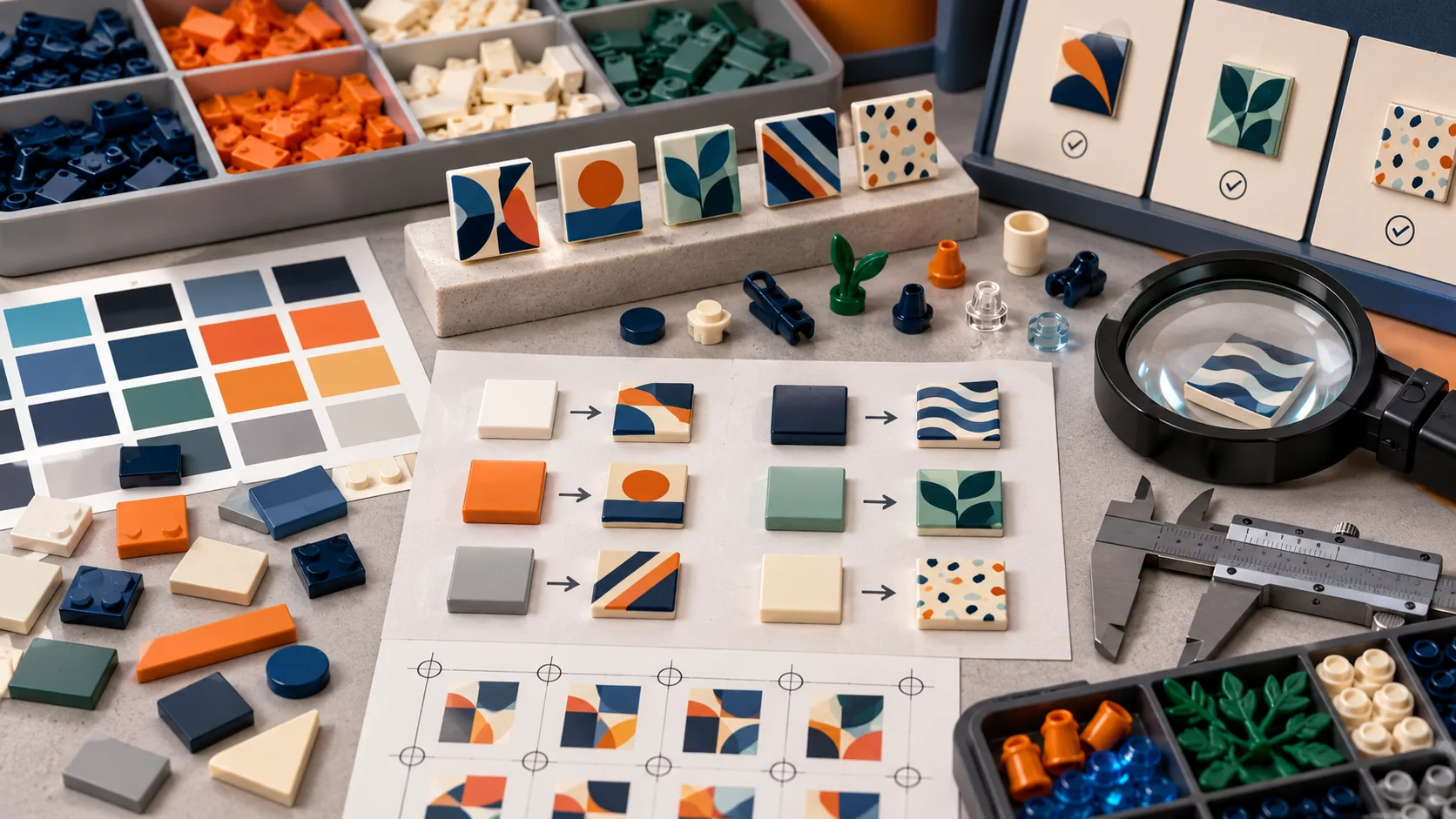
Custom printed building-block parts can add a logo, control panel, artwork or product detail without the cost of a completely new mold. The right process depends on the piece geometry, artwork, number of colors, durability requirement and order quantity.
When printing is the right customization method
Printing is useful when an existing compatible tile or accessory already has the correct shape. Common applications include company logos, gauges, signs, decorative patterns, faces for original characters and identification marks. Stickers may be better for very low quantities or large artwork areas, while a new mold is appropriate only when the geometry itself must change.
Information required for quotation
- Part type, dimensions and base color.
- Vector artwork and exact print position.
- Number of print colors and whether white underprint is needed.
- Quantity per design and number of designs.
- Rub, scratch or chemical-resistance expectation.
- How the part will be packed inside the final kit.
Sample-to-production workflow
| Step | Control point | Output |
|---|---|---|
| Artwork review | Lines, colors, bleed, orientation and rights. | Print-ready file |
| Part confirmation | Material, geometry, color and surface condition. | Approved blank part |
| Print sample | Registration, opacity, color and edge quality. | Physical sample |
| Durability check | Handling and application-specific wear. | Approved standard |
| Production | First-piece comparison and in-process sampling. | Printed batch |
| Kitting | Count, orientation and correct design per kit. | Production-ready packs |
Supply-chain advantage for small brands
TOSTUDY can coordinate the blank part, printing, color comparison, counting and final kit packing. This matters when one printed detail belongs inside a much larger BOM: it is checked against the approved model rather than treated as an isolated promotional item.
We recommend proving artwork on the real part before mass production. Fine lines that look clear on screen may fill in at small scale, while colors can appear different over dark plastic. An approved physical sample establishes the reference for production.
Quality points buyers should specify
- Maximum acceptable shift between print colors.
- Artwork orientation relative to studs or connectors.
- Opacity and base-color influence.
- Acceptable edge, dust and scratch criteria.
- Method for separating similar designs during kitting.
- Intellectual-property authorization for every logo or image.
Explore custom components and complete kit solutions for projects that combine printed elements with packaging.
Frequently asked questions
Can you print a logo on one tile?
We can evaluate the tile size, artwork and quantity. The design may need simplification to remain clear at small scale.
Is printing better than a sticker?
Printing provides an integrated finish; stickers can support larger or very low-volume artwork. The best choice depends on use, budget and durability.
Can several printed designs be packed in one set?
Yes. They should be clearly coded in the BOM and separated during counting to prevent mix-ups.
Review a custom printed part
Send the blank-part reference, vector artwork, quantity and intended use for feasibility feedback.