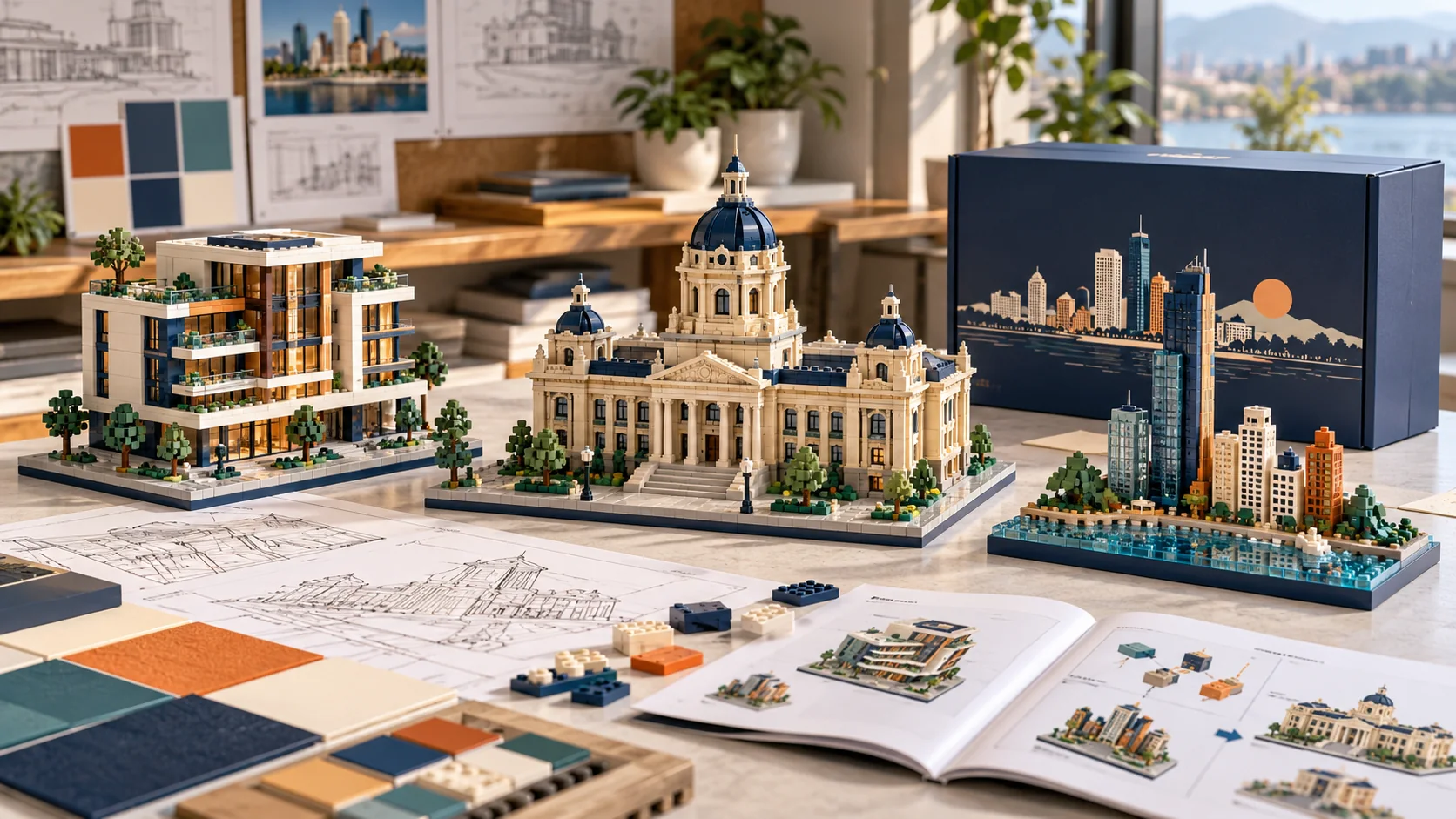
Custom architectural building-block kits turn a property, museum, factory or landmark into a model visitors can build and keep. They work as real-estate presentation gifts, museum-shop products, tourism souvenirs and anniversary pieces—but only when recognizable design, buildability, packaging and delivery are planned together.
Who uses architectural brick models?
- Real-estate developers: sales-center gifts, opening events and tenant welcome packs.
- Museums and cultural institutions: educational products and shop souvenirs.
- Tourism boards: recognizable skyline or landmark gifts.
- Factories and corporate campuses: anniversary and visitor-center models.
- Architects and agencies: presentation models for an approved campaign.
What makes a building recognizable at small scale?
A good model does not reproduce every window. It preserves the silhouette, façade rhythm, entrance, roofline, color relationship and one or two signature details. Before design begins, identify the views that matter most and the features that may be simplified. This keeps the model stable and the build experience appropriate for the recipient.
Development workflow
| Stage | Work | Approval |
|---|---|---|
| 1. Reference review | Confirm image rights, dimensions, audience, quantity and budget. | Design brief |
| 2. Model design | Translate important architectural features into available parts. | Digital views |
| 3. Sample build | Check stability, proportions, colors and assembly experience. | Physical sample |
| 4. Kit engineering | Finalize BOM, spare pieces, bag order and instructions. | Production specification |
| 5. Packaging | Prepare insert, gift box, labels and master cartons. | Artwork proof |
| 6. Production | Source, count, inspect, pack and verify complete kits. | Shipment release |
Supply-chain advantages for landmark projects
Architectural kits often combine common structural pieces with unusual colors, transparent elements, printed signs and presentation packaging. TOSTUDY coordinates these requirements under one BOM and one approved sample. Available compatible parts are used wherever practical, while custom printing or special colors are reserved for details that genuinely improve recognition.
For a lower-risk launch, begin with a sample and pilot quantity. After visitor or customer feedback, the BOM and manual can be refined for repeat production. MOQ depends on stocked parts, custom color, printing and packaging rather than one universal number.
Buyer checklist
- Use only photographs, plans, logos and building designs you are authorized to reproduce.
- Define finished dimensions and preferred build time.
- Specify recipient age and destination-market labeling requirements.
- Test the instructions with someone outside the design team.
- Approve colors under stable lighting and keep a sealed reference sample.
- Match the retail or gift box to the real shipping environment.
See our corporate and cultural gift solution or custom kit service for packaging and production options.
Frequently asked questions
Can you work from photographs only?
Yes, when the photographs clearly show the main elevations and important details. Drawings and dimensions improve accuracy but are not always essential for a stylized model.
Can one design be sold in a museum shop?
Yes. The design, age grading, packaging, instructions, testing and labeling should be planned for the intended retail market.
Can we create several buildings as one collection?
Yes. A shared scale, base format, box system and color language can make future landmarks easier to add.
Turn a place into a buildable keepsake
Send authorized references, target size, quantity and delivery market for a practical development plan.