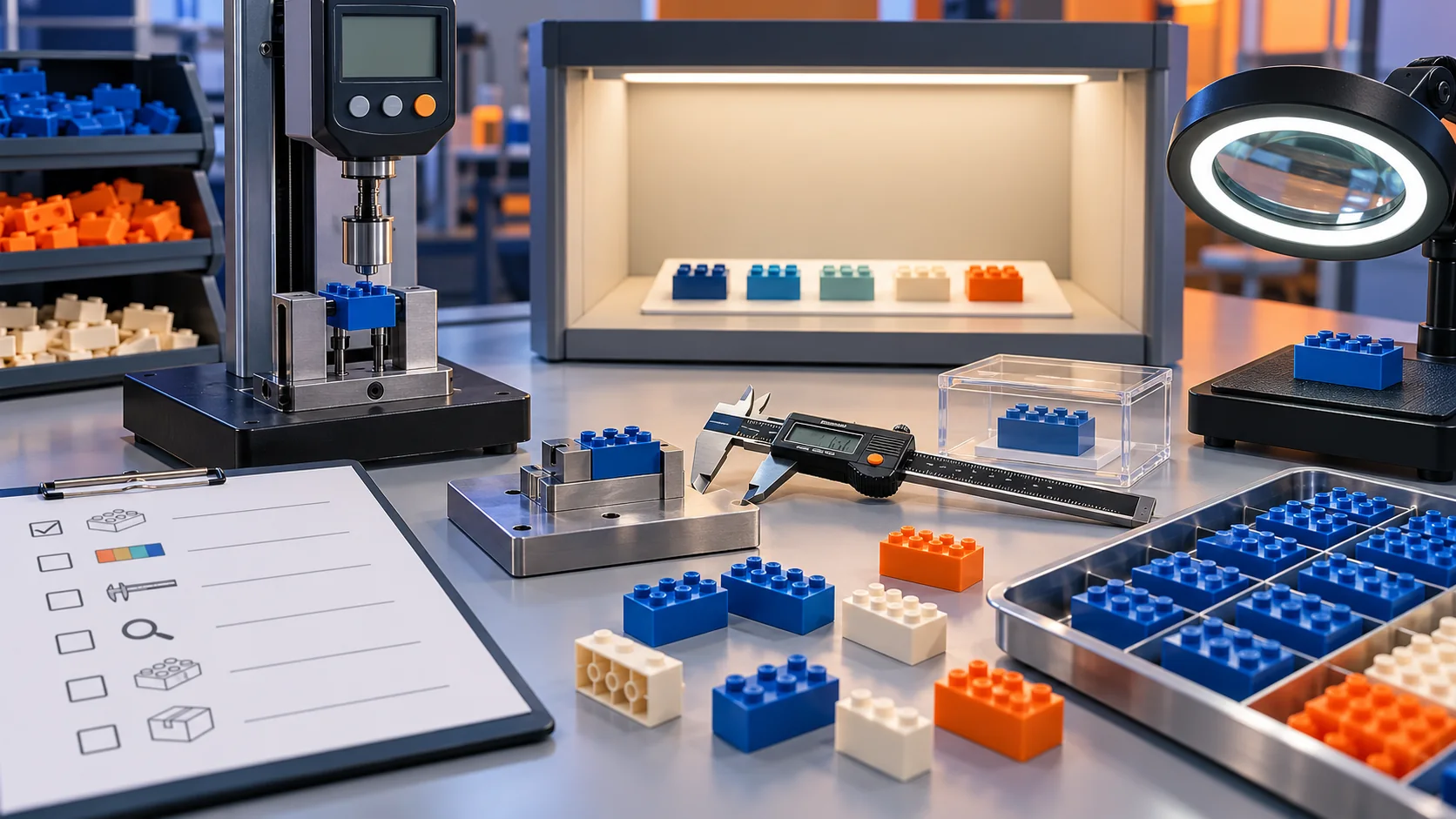
Reliable building-block parts must connect consistently, match approved colors, perform their mechanical function and arrive in the correct quantity. A useful quality plan measures these risks from sample approval through kitting instead of relying on appearance alone.
Clutch and functional fit
Clutch describes how securely pieces connect and how much force is needed to assemble or separate them. Too loose and a model becomes unstable; too tight and the build is frustrating or parts may deform. Functional elements such as pins, axles, gears and hinges also need application-specific checks, because nominal dimensions alone do not prove that a mechanism will work.
Five quality controls for complete kits
| Control | What to check | Reference |
|---|---|---|
| Dimensions | Critical geometry and connection points. | Drawing or approved part |
| Clutch/function | Assembly force, retention and movement. | Test method and mating parts |
| Color | Hue and batch consistency under stable light. | Approved color sample |
| Appearance | Burrs, scratches, deformation, marks and contamination. | Defect standard |
| Completeness | Part count, bag sequence, spares and manual version. | Final BOM |
Color approval needs controlled conditions
Plastic color can appear different under daylight, office lighting and photography. Compare production parts with an approved physical sample under a consistent light source. For projects combining several batches, review the assembled model as well as individual pieces because small differences may become more visible across a large surface.
Counting and traceability
A complete kit can use a combination of automated counting, controlled weighing, bag-level checks and final audits. Similar-looking parts require extra separation. Batch records should connect the approved BOM, production date, inspection result and packing version so a problem can be investigated without guessing.
TOSTUDY supply-chain quality approach
Our advantage is coordinating component supply with the finished kit. A part may pass an isolated measurement but still fail in the intended build, so sample assembly and functional checks are included where relevant. We align parts, printed elements, numbered bags, instructions and packaging to the same approved specification.
Requirements differ by project and market. Buyers should state destination-country testing, labeling and documentation needs during quotation rather than assuming a generic compliance claim applies to every configuration.
Supplier audit questions
- Which dimensions and connections are critical?
- How is the approved color sample stored and compared?
- What happens when a part is unavailable between batches?
- How are printed parts and similar variants separated?
- How are counting and final kit audits recorded?
- How are specification revisions controlled?
Explore our professional components or send a BOM through the contact page for a project-specific quality discussion.
Frequently asked questions
Is a visual inspection enough?
No. Functional connections, color comparison and kit completeness need defined checks in addition to appearance.
Can you test a sample before a larger order?
Yes. A physical sample establishes the model, parts, colors and packing reference before production.
How do you reduce missing parts?
Use a frozen BOM, controlled bag plan, counting or weighing controls, defined spares and final kit audits.
Define quality before production
Share your BOM, critical parts, target quantity and market requirements for a practical inspection plan.